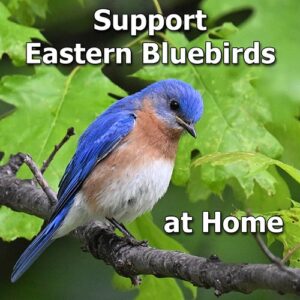
Simple Ways to Help Eastern Bluebirds
Episode 116
🦋
Find us on your favorite listening app.















Summary
In this episode, Ashley Kennedy and I discuss simple ways that anyone can help eastern bluebirds. Our discussion is based off her recently published research looking at the diets of nestling eastern bluebirds. You can find our discussion of her research and its results in episode 115.
Today’s guest
Ashley Kennedy is an entomologist who recently published her research on what eastern bluebird nestlings eat.
3 things you’ll learn from this episode:
- Simple ways to support eastern bluebirds and make a difference without getting overwhelmed.
- 2 resources for discovering caterpillar host plants.
- Some of the interactions between plants and the insects that eat them.
Resources:
- Ashley’s research
- Gardening for Moths a Regional Guide *
- New Research Reveals Diet of Baby Eastern Bluebirds (episode 115)
- The Backyard Ecologist’s Newsletter
- Backyard Ecology™ Community
* affiliate link – We receive a small commission for purchases made through affiliate links, but it comes at no extra cost to you. All commissions that we receive through these links goes toward producing Backyard Ecology™ content. We appreciate your support.
Thank you!
We want to say a big “Thank you!” to all our financial supporters who help us provide free educational content about the plants, pollinators, and wildlife that can be found in our yards and communities.
Join our financial supporters in helping us produce free content for everyone.
It doesn’t take much if we all work together. If everyone who hears this contributed just $2-3 / month (or the cost of one bottle of soda / month), we would be able to produce a whole year’s worth of videos, podcasts, blogs, newsletters, and other free content.
Ways to contribute include:
- Monthly contributions.
- One-time donation online.
- Mailing a check to Backyard Ecology, P.O. Box 652, Glasgow, KY 42142-0652.
If you would like personalized help creating your own pollinator and wildlife habitat, then we encourage you to check out the Backyard Ecology™ Community.
There’s lots of great “big picture” information available about creating pollinator gardens or larger habitats for pollinators and wildlife. What’s lacking are opportunities to say, “This is what I want to do. This is what I’m struggling with. How do I make it work on my property?”
That’s part of what the Backyard Ecology™ Community offers its members every day.
Thank you!
These amazing individuals go above and beyond every month to provide financial support which helps us create so much free content for everyone to enjoy and learn from.
Julie Krygier, Lizabeth, Russel Furnari, Ubiquisquish, Karen Veleta, Kevin B, Crystal Dyamonds, Mitchell Bell, Sue Ann Barnes, Adrienne Richardson, Ariel, Cara Flinn, Cathy, Michael, Tom Winner, Eric Fleming, Julie, SB H, Craig, Rachel Antonucci, Melissa Egbertson, Switzy, Vilma Fabre, Pia O Nomata, Patrick Dwyer, Paul Gourley, John Master, Debra, Ayn Zitzman, Debra Moore, Han Mad, Isaac Kowis, Cathy Anderson, Betsy Lessels, Reid, Dave Teare, I’m Trying for Good, Jeff, Richard, Chris Peterman, Ann Farrer, Carol, Hunter Strickland, Tyler Dowdy, Gabriel Madison, JCS, Birderswithdogs, Michael Larkin, K Firth, Irene Lofstrom, Vegan Street, and Shannon C.
Backyard Ecology™: Creating thriving backyard ecosystems that you can enjoy and be proud of
We created Backyard Ecology™ to help you confidently create pollinator and wildlife habitat that you can enjoy and be proud of. Because nature isn’t just “out there.” It’s all around us, including right outside our doors.
Our focus on the eastern U.S. means that the information we share is applicable to you and where you live. Join us as we ignite our curiosity and natural wonder, explore our yards and communities, and improve our local pollinator and wildlife habitat.
Backyard Ecology™’s Guiding Principles:
🦋 Curiosity: Nature is fun, interesting, and worth exploring. We will never know everything. Answers lead to more questions. That’s half the fun.
🦋 Balanced: You don’t have to choose. You can support nature AND have a beautiful property that you can enjoy and be proud of.
🦋 Science informed: Habitat creation and management should be based on the latest scientific research available. This is true regardless of whether you’re working in a small garden or on hundreds of acres.
🦋 Stewardship: Anyone can make a positive difference in the natural world and leave an ecological legacy on their property.
Leave a Reply